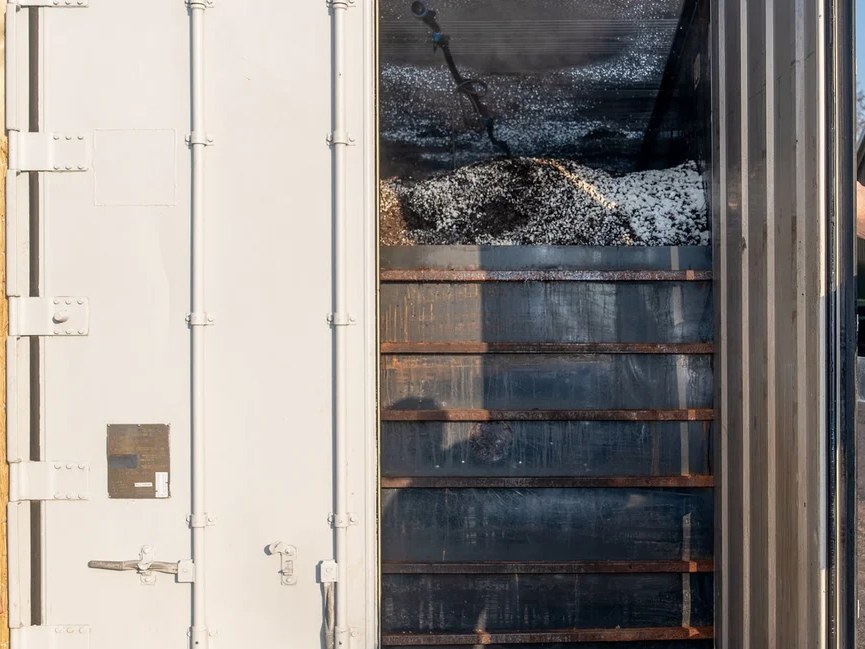
Exceptionally fungus-rich compost
Our compost has a fully grown mycelium network. Two things make that possible. The bed stays undisturbed from start to finish, so the hyphae can grow on uninterrupted for weeks into a continuous network. And the temperature is steered through exactly the windows in which fungi establish and spread, first the heat-loving lignin decomposers and then the species that carry the maturation.
Free of weed seed, nematodes and pathogens
Temperature and moisture are steered across the whole volume and measured at ten points. Every kilo therefore gets the same thermal treatment, for long enough and at the moisture content at which that treatment actually works. Weed seed, nematodes, insect larvae and plant-pathogenic fungi and bacteria are killed off. For every batch we record the full course of the process, so the treatment can be demonstrated rather than assumed.
Rich in species
The process stays in the window between 55 and 60 °C, hot enough for full sanitation and cool enough to keep the range of species that has to carry the compost afterwards. What you get is a broad, active community of bacteria, actinomycetes and fungi that complement one another. That diversity can be established through DNA analysis of the end product.
Compost that holds water
Humified organic matter holds many times its own weight in water, and the fungal network binds the particles into aggregates with an open pore structure. Both are formed in the maturation phase, which in our process runs to completion under steered temperature and moisture. On top of that, the material never leaves the process dried out. Compost that has once dried through becomes water repellent and only takes up moisture again with difficulty. In dry spells that difference is felt straight away in the soil.
Compost that puts its nitrogen to work
Ammonia loss rises steeply with temperature. By capping the peak at 60 °C the nitrogen stays in the product instead of in the air, and largely in organically bound form. That form is released gradually, when the crop asks for it, and does not wash away with the first rain.
The same compost from every batch
The process runs inside a closed container, cut loose from weather and season. Temperature, moisture and oxygen are steered per phase according to a fixed recipe. The same input therefore yields the same compost, in January and in July. For anyone growing on their own compost, that predictability shows up directly in crop response.